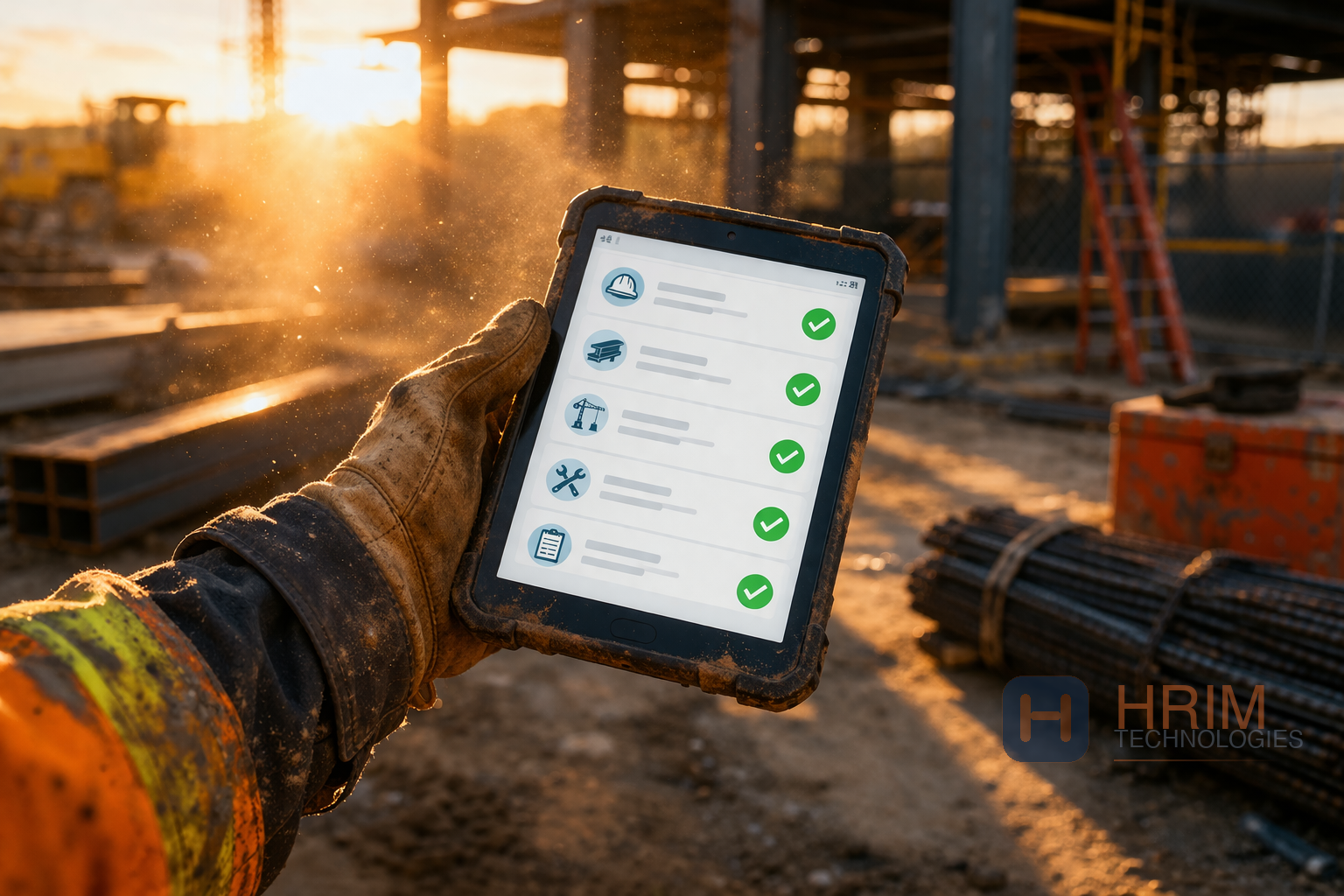
The construction industry has embraced digital tools - in the back office. Project management, estimating, BIM modeling, and accounting are all software-driven. But walk onto a jobsite and you will still find paper drawings, verbal instructions, and daily logs written in notebooks.
The field adoption gap
74% of AEC firms report using AI or digital tools in at least one project phase. But field crew adoption of mobile tools remains below 40%. The tools are available. The resistance is not Luddism - it is poor design for the actual conditions of construction work.
Design for gloves, dust, and sunlight
Construction workers wear gloves. They work in direct sunlight. Their hands are often dirty or wet. Touch targets need to be large. Screens need to be readable in bright light. Input methods need to work with gloved hands or voice. Most construction apps are designed by people who have never stood on a scaffold.
Offline-first is not optional
Jobsites have unreliable connectivity. An app that shows a spinner when it cannot reach the server is useless at the one place it needs to work. Offline-first architecture - where the app works fully without a connection and syncs when connectivity returns - is a hard requirement, not a nice-to-have.
Reduce input, increase capture
Field workers should not be filling out forms. They should be taking photos, recording voice notes, and tapping pre-filled checklists. Every keystroke on a jobsite is a barrier to adoption. The best construction software captures data as a byproduct of doing work, not as a separate data-entry task.
The ROI argument that works
Do not sell field software on efficiency gains. Sell it on risk reduction. A digital daily log with timestamped photos is a legal defense in a dispute. An automated safety checklist is an OSHA compliance record. When the value proposition is protection, not productivity, adoption follows.