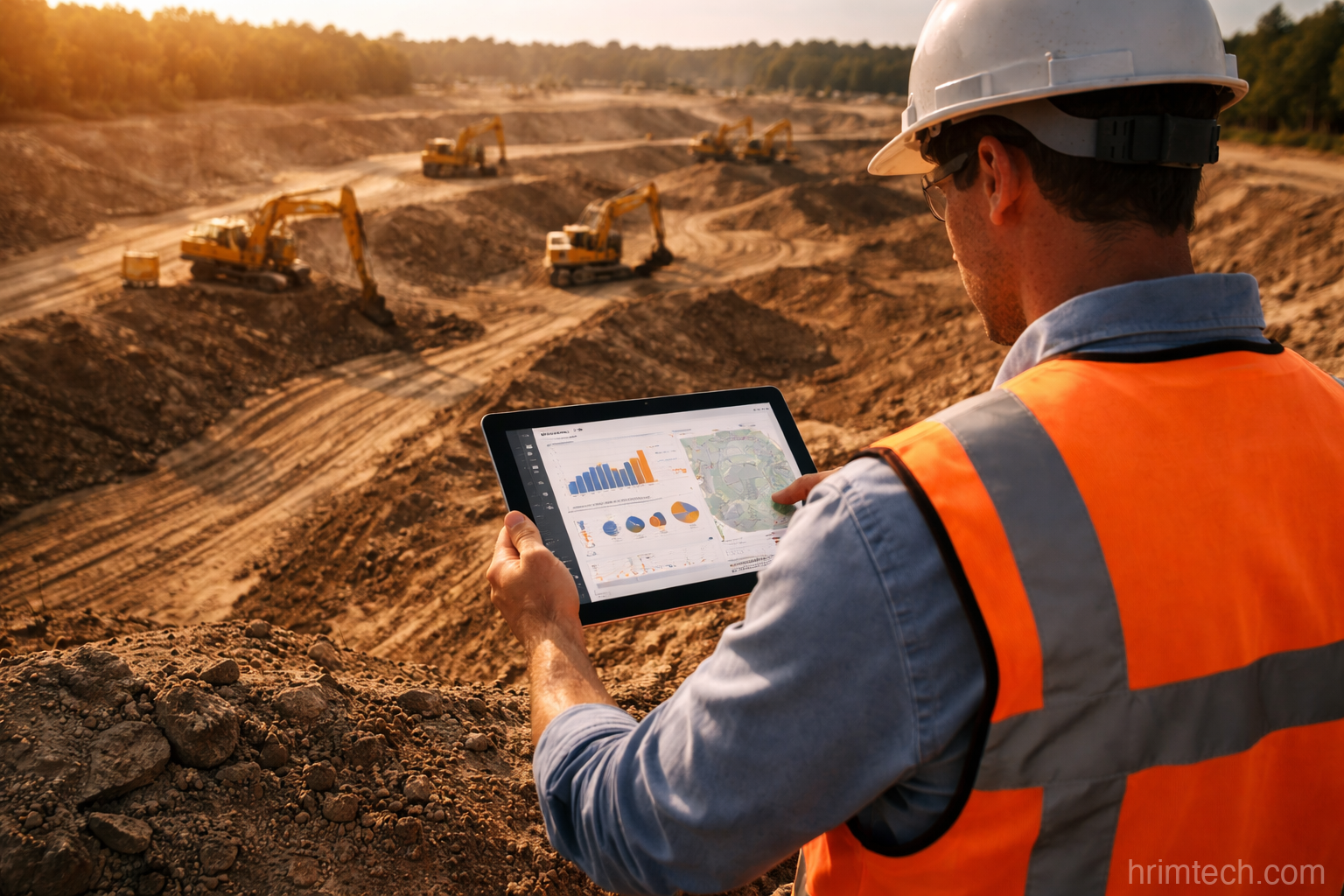
Construction has a $2 trillion labor problem. According to the Associated General Contractors of America, 85 percent of contractors report difficulty finding skilled equipment operators, and the shortage worsens each year as the workforce ages. Bedrock Robotics, a San Francisco startup founded in 2024 by engineers who built Waymo's autonomous trucking systems, closed a $270 million Series B round in February 2026. The round was co-led by CapitalG and the Valor Atreides AI Fund, with participation from NVIDIA's venture arm NVentures and MIT, and values the company at $1.75 billion. Their pitch is direct: if self-driving cars can navigate chaotic city streets, self-driving excavators can navigate chaotic construction sites.
What They Do
Bedrock Robotics makes the Bedrock Operator, an AI controller that retrofits existing heavy equipment for supervised and fully autonomous operation. The system uses LiDAR sensors and GPS for positioning, combined with machine learning models trained on data from experienced human operators.
The learning loop mirrors what Waymo did with driving. A skilled operator runs the machine through a task, whether excavating a trench, loading a dump truck, or compacting a stretch of road. The Bedrock Operator records those actions at the control level, from hydraulic pressure to bucket angle to swing speed, and trains on them. Once trained, the machine executes the same class of task autonomously, adjusting for variations in soil conditions, equipment load, and site geometry.
According to Bedrock's Series B announcement, their machines have moved over 65,000 cubic yards of material on a single Southwest project, autonomously loading human-operated articulating dump trucks in the same cycle pattern used in manual operations. The excavator dug, filled, and repositioned for each truck cycle without a human in the cab.
The company emerged from stealth in July 2025 with $80 million in Seed and Series A funding. By November 2025, it completed a large-scale supervised autonomy deployment on a 130-acre manufacturing site. The Series B accelerates the path to fully operator-less deployments, which Bedrock targets for 2026.
Why It Matters
The construction industry generates approximately $13 trillion in global economic activity annually, according to McKinsey. It is also one of the least automated industries in the world. McKinsey's automation index estimates construction has a 64 percent technical automation potential, yet actual adoption sits near the bottom of every sector they measure. The reason is environmental complexity. Factories are structured. Warehouses are structured. Construction sites are not. Every jobsite has different terrain, different soil, different layout, and different sequencing requirements. That complexity is exactly what the Waymo school of machine learning was built to handle.
Bedrock's model does not eliminate operators. It multiplies them. A single site manager overseeing a Bedrock-enabled fleet supervises multiple autonomous machines simultaneously. The experienced operator becomes a fleet manager and exception handler. Instead of one skilled operator per machine, one operator manages a synchronized fleet. On a labor-constrained project, that ratio changes the economics entirely.
Co-founder and CEO Boris Sofman led autonomous trucking and core technologies at Waymo before founding Bedrock. The founding team includes co-founders Kevin Peterson, Ajay Gummalla, and Matthieu Guilbert, all with deep autonomous systems backgrounds. According to CapitalG's investment thesis, published alongside the Series B announcement, the team is addressing the largest industrial sector that autonomy has yet to touch.
The Numbers
Bedrock Robotics has raised more than $350 million in total funding. The $270 million Series B, closed in February 2026, was co-led by CapitalG and the Valor Atreides AI Fund. Strategic investors include NVIDIA's NVentures, MIT, Eclipse, 8VC, Tishman Speyer, and Incharge Capital. The company was founded in 2024 and reached a $1.75 billion valuation with this round, according to Electrek's reporting on the round. Their autonomous systems have already moved dirt on commercial projects in the Southwest. First fully operator-less excavator deployments with paying customers are on the 2026 roadmap.
What To Do About It
1. Start modeling autonomous equipment into your 2027 and 2028 procurement cycles. Bedrock's deployments are happening in 2026. That means procurement conversations, pilot assessments, and site integration planning belong in the next budget cycle, not a future one.
2. Audit your site data infrastructure before autonomous equipment arrives. Autonomous machines generate continuous telemetry: sensor readings, cycle counts, load data, positioning, and site mapping. That data needs to feed project management and site operations platforms. Assess whether your current stack can ingest and act on autonomous equipment data before you sign a deployment agreement.
3. Revise your labor planning ratios. If your project models assume a fixed ratio of equipment operators to machines, autonomous equipment breaks that assumption. Workforce planning needs a new model: fewer direct operators, higher supervision ratios, different skill requirements. The skilled operators you are struggling to hire today become the fleet managers who oversee ten machines instead of one.
4. Engage your insurance carriers and legal team on autonomous equipment liability now. When an autonomous excavator damages a utility line or injures a worker, the liability chain looks different than a human-operator incident. Define accountability before deployment, not after an incident.
HRIM's Take
Bedrock Robotics is applying the Waymo playbook to an industry that makes Waymo's challenge look structured. Construction sites change daily. Soil conditions vary by the foot. Equipment works in concert with humans who are not following a script. The fact that Bedrock's machines are already moving 65,000 cubic yards on real commercial projects, not in a lab, means the technology has cleared the hardest bar: it works in the chaos of real work. The construction industry's labor shortage is not a market cycle that will self-correct. It is a structural demographic shift. Companies that adopt autonomous equipment early will build projects faster and at lower cost than those waiting for the workforce to recover. Bedrock has the pedigree, the funding, and the dirt-on-the-ground proof. That is not a bet on future technology. That is a bet on execution.